

Why Can’t You Turn Your Brain Off at Night, Even When You’re Exhausted?

You’re bone tired. Your body is heavy, your eyes are sore, and you’ve been looking forward to sleep since mid-afternoon. Then you lie down — and your mind takes off at full speed. Deadlines, old conversations, tomorrow’s to-do list, that one thing you said three weeks ago. None of it feels optional. None of it feels like something you’re choosing to think about.
This experience is far more common than most people realize, and there’s real neurological reasoning behind it. Understanding what’s actually happening in your brain at night is the first step toward changing it.
The Brain at Night: Why Quiet Hours Feel Anything But Quiet
During the day, your attention is constantly pulled outward — tasks, screens, people, noise. That external stimulation keeps your brain occupied. The moment you lie down, and the room goes dark, that outward pull disappears. Your brain doesn’t simply power down in response. Instead, it turns inward.
Neuroscientists call the network responsible for this the default mode network (DMN) — a system that activates during rest and self-referential thinking. As sensory input fades, the brain perceives the silence as a void to be filled and begins scanning for potential problems. This isn’t irrational behavior. It’s an evolutionary survival mechanism that kept your ancestors alert during vulnerable nighttime hours. The problem is that the modern brain is running ancient threat-detection software in a world where the “threats” are unanswered emails, financial stress, and unresolved social tension — not physical danger.
If nighttime anxiety is affecting your sleep and daily functioning, speaking with a provider who offers anxiety treatment to North Austin patients may help you address the cycle at its root, not just manage the surface symptoms.
The Cortisol and Melatonin Imbalance
Sleep is governed by a careful hormonal balance. As evening arrives, melatonin should rise, and cortisol (your primary stress hormone) should taper off. In a chronically stressed or anxious nervous system, this balance is disrupted. Cortisol stays elevated when it should be declining, keeping the brain in a state of alertness precisely when the body needs to wind down.
Research published in the journal Sleep found that a sleepless night can cause emotional stress levels to increase by up to 30%. That statistic captures something most anxious poor sleepers already know instinctively — the nights get harder, and the days get harder right along with them. When you’re stressed, you don’t sleep well. When you’re sleep-deprived, you get more stressed. It’s a cyclical relationship that feeds on itself.
Racing Thoughts vs. Rumination: Are They the Same Thing?
These two terms often get used interchangeably, but they describe slightly different experiences, and the distinction matters for treatment.
Racing thoughts involve a rapid, often uncontrolled stream of ideas, worries, or images moving quickly from one to the next. The content changes fast. It can feel almost frantic, like a browser with fifty tabs open and no way to close them.
Rumination is more circular. The same worry, the same regret, the same unresolved scenario loops repeatedly.
Both patterns respond to treatment, but the most effective approaches differ slightly. Rumination tends to respond to structured cognitive work. Racing thoughts often respond better to attention-redirection techniques that gently shift the mind toward neutral, less emotionally charged material.
The Anxiety Connection: Why It Gets Worse at Night
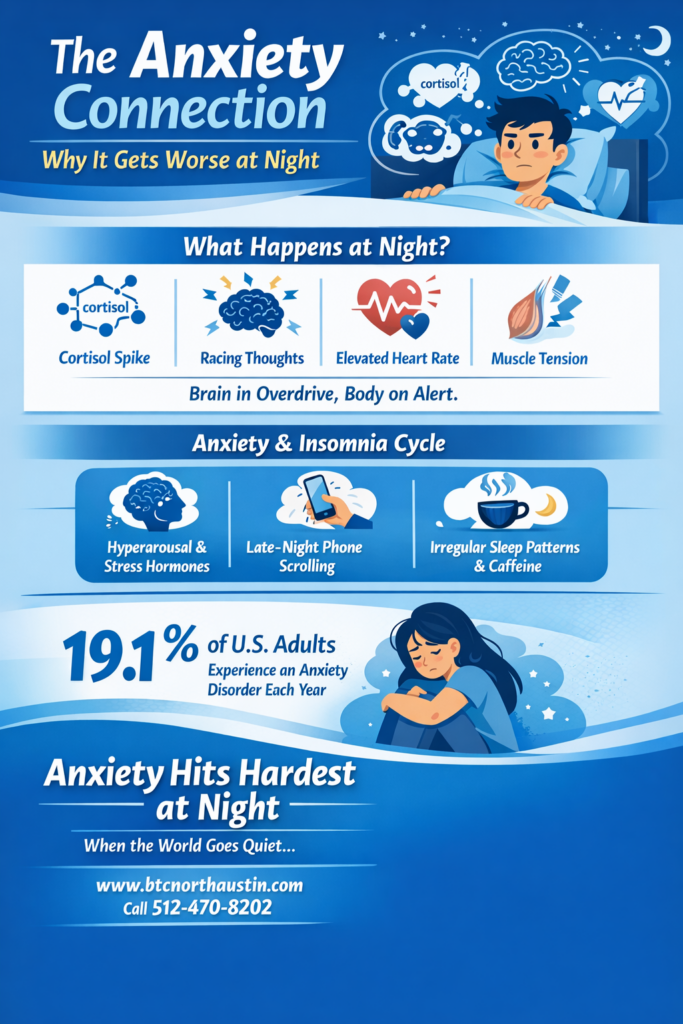
Anxiety doesn’t create racing thoughts out of thin air. It amplifies what’s already there by keeping the sympathetic nervous system (the fight-or-flight system) switched on when it should be switching off. Anxiety triggers cortisol release, muscle tension, elevated heart rate, and a brain working overtime. This is the opposite of the physiological state required for sleep.
Anxiety and insomnia share biological pathways: hyperarousal, stress hormones, and changes in the sleep-regulating networks of the brain. Behaviorally, anxiety also drives habits that compound the problem — late-night phone scrolling, irregular sleep schedules, caffeine used to compensate for poor sleep — all of which feed back into the cycle.
An estimated 19.1% of U.S. adults experienced an anxiety disorder in the past year. For many of them, nighttime is where anxiety is most visible and most disruptive. The daytime coping strategies, like staying busy, staying distracted, stop working the moment the room goes quiet.
Source: Trey Jones
What Helps: Evidence-Based Strategies
Before considering clinical treatment, several research-backed behavioral strategies can shift the pattern for people whose racing thoughts are moderate rather than severe.
Scheduled Worry Time
Setting aside 15–20 minutes earlier in the evening to write down thoughts, tasks, or worries can reduce the brain’s “note-to-self” drive at bedtime. This works by externalizing the content — once it’s on paper, the brain’s drive to keep it in active memory decreases. Research from Baylor University found that writing a to-do list for the next day helped participants fall asleep faster than those who journaled about completed tasks.
Breathing to Activate the Parasympathetic System
Slow, regulated breathing activates the parasympathetic nervous system, helping the body shift from fight-or-flight toward rest. Studies confirm that these techniques lower heart rate, reduce cortisol levels, and decrease the cognitive hyperarousal that drives racing thoughts at night. A 4-count inhale, 4-count hold, and 6-count exhale is a commonly used pattern — the longer exhale is what signals safety to the nervous system.
Cognitive Shuffling
Rather than telling yourself to “stop thinking” — which almost never works — cognitive shuffling gently redirects attention toward neutral, random mental images. Research in CBT-I shows that neutral mental imagery reduces mental arousal and helps the brain transition into sleep mode by occupying working memory and disrupting repetitive worry loops.
Get Out of Bed If You’re Still Awake
Sleep specialists generally recommend getting out of bed if you haven’t fallen asleep within about 20 minutes. Staying awake in bed causes the brain to associate the bed with wakefulness rather than rest. A quiet, low-stimulation activity in a dimly lit room until sleepiness returns helps break that association over time.
When Self-Help Strategies Aren’t Enough
Behavioral strategies help many people. They don’t help everyone. For people dealing with a diagnosed anxiety disorder, chronic stress, PTSD, or related conditions, the underlying neurological dysregulation requires more than better bedtime habits.
Cognitive Behavioral Therapy for Insomnia (CBT-I) is the first-line, evidence-based treatment for chronic insomnia, targeting the thoughts and behaviors that maintain poor sleep. For anxiety-driven sleep disruption specifically, CBT and related therapeutic approaches address the hyperarousal at the source rather than just managing its nightly expression.
If you’ve been lying awake night after night, trying everything and still watching the clock hit 2 a.m., it may be time to look at what’s actually driving the pattern. Schedule a consultation with Brain Treatment Center North Austin and get a personalized assessment of what’s keeping your brain switched on when it should be resting.
People Also Ask
Q: Is it normal for anxiety to only appear at night and not during the day?
Yes, and it’s more common than people expect. Daytime distractions keep the brain externally focused, which effectively suppresses anxious thought patterns. When those distractions disappear at bedtime, the same anxiety that was present — but masked — during the day has nowhere to hide. Many people with generalized anxiety disorder first become aware of it through nighttime symptoms rather than daytime distress.
Q: Can a consistent sleep schedule actually help with anxiety-driven insomnia?
It can, significantly. A consistent wake time (even after a poor night’s sleep) helps anchor the circadian rhythm and gradually shifts the timing of cortisol and melatonin release. Over several weeks, this creates more predictable sleep pressure and reduces the nighttime hyperarousal that anxiety produces. It’s one of the core components of CBT-I for this reason.
Q: Why do worries feel so much more catastrophic at 2 a.m. than they do the next morning?
This is partly neurochemical. At night, the prefrontal cortex (the brain region responsible for rational perspective) is less active. The amygdala, which processes threat and emotional intensity, tends to dominate. The same worry that feels manageable during the day can feel genuinely alarming at midnight because the brain’s rational filter is partially offline. Things don’t get worse overnight; the brain just loses its capacity to contextualize them.
Q: Could racing thoughts at night point to something other than anxiety?
Possibly. Racing thoughts are also associated with ADHD, bipolar disorder, trauma-related conditions, and certain sleep disorders. If racing thoughts occur alongside difficulty concentrating during the day, mood swings, physical restlessness, or intrusive memories, it’s worth a full evaluation with a mental health provider rather than treating only the sleep symptom.
Q: What is MeRT, and how does it differ from medication for anxiety?
MeRT (Magnetic e-Resonance Therapy) is a personalized, non-invasive brain stimulation treatment. It begins with a qEEG brain mapping assessment to identify abnormal patterns in an individual’s brainwave activity, then delivers targeted magnetic stimulation calibrated to those specific patterns. Unlike medication, which alters the neurochemistry systemically, MeRT works directly at the level of neural function. It’s drug-free, painless, and available at Brain Treatment Center North Austin for patients in the North Austin and Round Rock area.



Take the First Step in Finding out if You might Benefit
Our New Patient Coordinator is here for you. She will take the time to listen to your concerns and carefully explain all the details and information you need. She can answer any questions that you may have. If, after this, you would like to schedule a consultation with the Doctor, she can do that.